One Messenger Is Not Enough: Choosing the Right Channel for Every Conversation
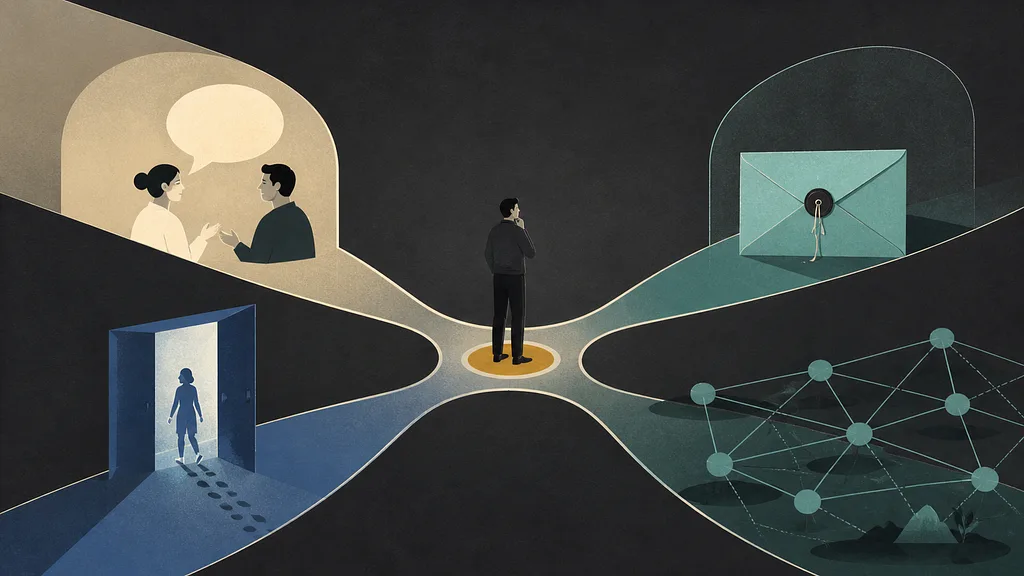
Everyday chat, passwords, temporary identities, work, and crisis communication do not ask for the same kind of privacy. We talk about messengers as if they were interchangeable containers: choose the one with the strongest encryption, move every conversation there, and the problem is solved. Real communication is less tidy.
A family group needs reliability and effortless contact discovery. A support team needs search, retention, and accountable administrators. A journalist meeting a source may want no phone number, no reusable handle, and minimal relationship metadata. A person transferring an API token should not create a permanent chat record at all. During an internet shutdown, the best cloud service is the one you cannot reach.
The best messenger is not the one with the longest security checklist. It is the one whose failure modes fit the conversation.
This article is not a universal ranking. It is a research-based map of communication use cases, architectural choices, and trade-offs — including the moments when a messenger is the wrong tool.
Security is not a leaderboard
“Secure” can describe several different properties that are easy to confuse. Content confidentiality asks whether the service or a network observer can read the message. Identity privacy concerns whether you must reveal a phone number, email address, domain, or stable public identifier. Metadata resistance measures who can infer that two people communicated, when, and from which network. Authenticity determines whether you can verify that the recipient is the person or device you intended. Availability asks whether communication survives a server outage, censorship, account suspension, or loss of internet access. Recovery concerns what happens when a device is lost or a new device is added. Governance asks whether an organization can retain, export, moderate, or revoke access to business records.
No architecture maximizes every property. Easy recovery can require durable encrypted backups. Contact discovery can expose a stable identifier. Strong organizational oversight is almost the opposite of personal anonymity. Offline resilience often means fewer conveniences and more manual trust decisions. The practical question is therefore not “Which messenger is safest?” but “What consequence are we trying hardest to prevent?”
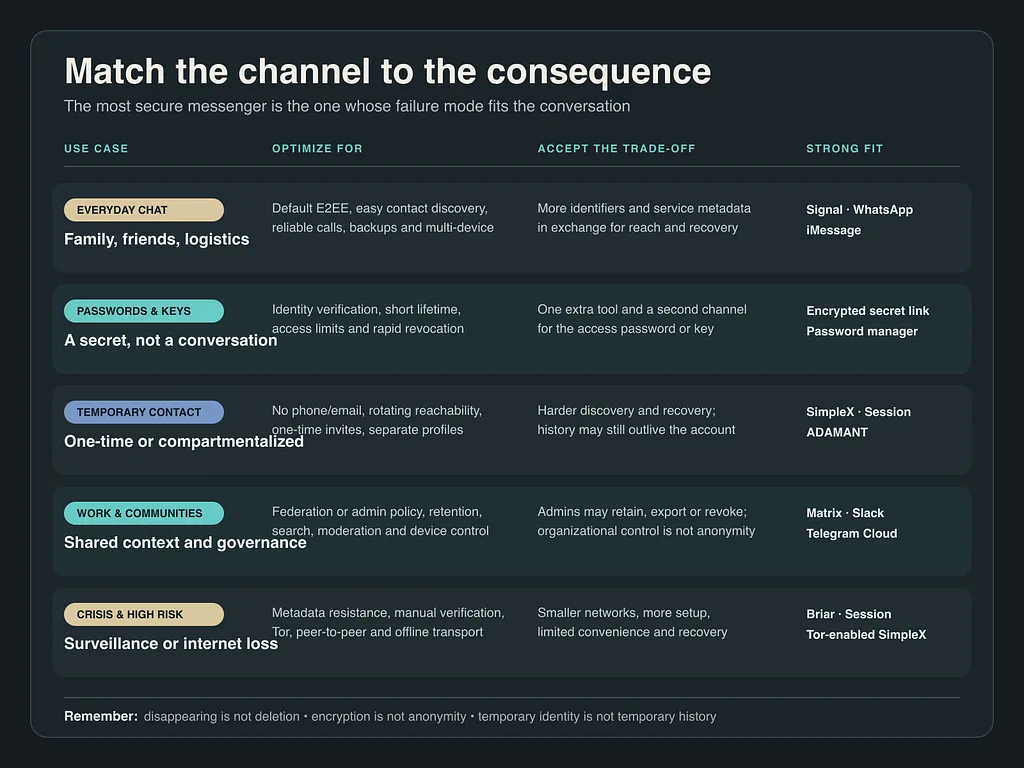
Everyday communication rewards strong defaults
For daily conversations, adoption is part of security. A technically excellent messenger that friends, relatives, or customers will not use simply pushes them back to SMS, email, or screenshots.
WhatsApp’s private messages and calls use end-to-end encryption by default. Signal also makes end-to-end encryption the normal mode, adds safety-number verification, and lets people initiate contact with usernames while keeping phone numbers out of profile details. Apple’s iMessage provides end-to-end encryption inside the Apple device ecosystem. These products are strong fits when the priority is a private conversation that feels ordinary.
The trade-off is identity and ecosystem coupling. Signal still requires a phone number to register, even though usernames can reduce what is shared with new contacts. WhatsApp is built around phone-number identity and large-scale reach. iMessage is at its best when everyone is using compatible Apple devices.
Recovery also matters. Multi-device access and encrypted backups can protect a family’s history from a lost phone, but they expand the number of devices, credentials, and recovery mechanisms that must be secured. End-to-end encryption protects the route between endpoints; it does not protect an unlocked endpoint, a compromised operating system, a copied export, or a recipient who photographs the screen.
For normal life, the right goal is usually not anonymity. It is a strong encrypted default, understandable identity verification, protected devices, and a recovery model the participants can actually manage.
Cloud convenience, communities, and work need different trust
Large communities and workplace conversations prioritize continuity, moderation, search, integrations, and shared context. Those needs change the security model.
Telegram makes the distinction explicit. Cloud Chats are encrypted between client and server and stored in Telegram’s cloud so they can synchronize across devices. Secret Chats add end-to-end encryption, are device-specific, and are not part of the cloud. The product offers two different answers because durable multi-device history and device-bound secrecy are different use cases.
Matrix takes a federated approach: users and rooms can span independently operated homeservers, while encrypted rooms use device keys and the Olm/Megolm family of cryptographic ratchets. That gives communities and organizations infrastructure choice, but it also creates real device-verification and key-recovery work. Federation removes one global operator; it does not remove server administration or endpoint risk.
Slack represents another legitimate model. Its official materials emphasize encryption at rest and in transit, retention policies, data exports, legal holds, DLP, and optional enterprise key management. That is governance-oriented security. A company may need to preserve an incident timeline or satisfy a legal hold. Employees should not confuse that organizational control with a private channel beyond administrators and policy.
A useful rule follows: work chat is a business record unless policy clearly says otherwise. Use it for decisions that should survive; avoid treating it as an anonymous or deniable space.
Passwords and private keys are not messages
A password, recovery code, API token, wallet private key, or seed phrase is not ordinary conversational content. It is a capability: anyone who obtains it may be able to act as you.
That changes the preferred workflow. Instead of pasting a long-lived secret into a chat history, use a purpose-built encrypted sharing mechanism with expiration, access limits, and revocation. Bitwarden Send, for example, encrypts content client-side, keeps the encryption key out of server requests, supports deletion and expiration controls, and can require a password. Its documentation recommends sharing that password through a separate channel.
A good secret-transfer sequence looks like this. First, verify the recipient through an existing trusted channel or in person. Second, create a short-lived encrypted secret link with the smallest useful access count. Third, send the link through one channel and the access password or missing key fragment through another. Fourth, confirm receipt without repeating the secret in the conversation. Finally, delete or revoke the share, then rotate the credential if exposure would be costly.
Disappearing messages can reduce routine history, but they are not an adversarial deletion guarantee. Signal says this plainly: a recipient who wants a record can photograph the screen. Timers also do not erase notification previews, copied text, screenshots, exports, malware captures, or a secret already used elsewhere.
Use a messenger to coordinate the transfer. Use a dedicated secret-sharing tool to transfer the secret.
For wallet seed phrases and master recovery keys, the safest default is stronger still: do not transmit them through any messenger. Prefer an offline, verified handoff or a carefully designed multisignature or recovery process.
“Temporary communication” means four different things
People often ask for a temporary account when they actually need one of four properties: a temporary identity that is not linked to the everyday account, temporary reachability where an invitation or address stops accepting new contacts, temporary content where messages disappear from participating devices after a timer, or temporary metadata where infrastructure cannot easily connect the participants over time. These properties are not equivalent.
Signal usernames improve reachability privacy: they can be changed, and a username can initiate contact without revealing the phone number. But the account still requires a phone number at registration, and changing a username does not create a new cryptographic identity or erase existing chats.
Session removes the phone-number and email requirement and sends messages through decentralized onion requests so that no single routing node knows both origin and destination. That makes it attractive when stable civil identity and network origin should be separated from the conversation, although reach, recovery, and real-time features may not match mainstream platforms.
SimpleX goes further at the addressing layer: it does not assign a network-wide user identifier. Contacts connect through one-time or temporary links, and relay servers keep encrypted messages only until delivery. This reduces cross-contact correlation, but it also means discovery depends on an out-of-band invitation and local data management becomes important.
ADAMANT can generate an account locally from a BIP39 mnemonic without a phone number or email. That makes compartmentalized identities easy to create. But the account’s encrypted message transactions are written to a blockchain. The identity can be disposable; the accepted transaction history is deliberately durable.
A temporary account can reduce identity linkage. It cannot erase a record already copied, backed up, or committed to a ledger.
Before creating a “burner” account, decide which form of temporariness matters. Otherwise the system may solve the wrong problem.
High-risk and offline communication prioritize resilience
When the threat includes broad network surveillance, censorship, or an internet blackout, conventional cloud assumptions may fail.
Briar synchronizes directly between users’ devices. With internet access it can use Tor; without internet it can exchange data over Bluetooth or Wi-Fi. Contact lists remain encrypted on the device, and there is no central messaging server to block. This is a strong fit for journalists, activists, disaster response, and local coordination under disruption.
The trade-offs are substantial: smaller user networks, more careful contact introduction, device-local state, limited platform reach, and fewer mainstream conveniences. These are not product shortcomings so much as the cost of optimizing for a more severe failure.
Where ADAMANT fits
ADAMANT approaches messaging as a decentralized trust layer. Accounts are generated locally from a mnemonic passphrase; the resulting key pair signs transactions, and no registration authority needs a phone number, email address, or contact book.
Message assets are encrypted before they are packed into transactions. ADAMANT’s documentation describes NaCl box encryption using Curve25519 for key agreement, Salsa20 for encryption, and Poly1305 for authentication. The encrypted transaction is then signed and broadcast to the network, where independent nodes can validate its order and authenticity.
This produces a distinctive set of use cases: a sovereign identity that is not issued by a messaging company, communication history that does not depend on one provider’s database, censorship-resistant delivery and verifiable ordering, pseudonymous or compartmentalized accounts created without personal registration, and messaging integrated with transfers, bots, and blockchain services.
It also creates responsibilities. The mnemonic passphrase is the master secret: there is no help desk that can recover it, and it should never be sent through chat. Blockchain durability means encrypted payloads and required transaction metadata can outlive the device or the intention behind a temporary account. Encryption protects content; it does not make the existence and ordering of transactions disappear.
That is why ADAMANT is not simply “another encrypted chat.” It is most valuable when the conversation needs to survive an operator, remain independently verifiable, or begin without a centrally issued identity — and when participants accept the cost of self-custody and durable history.
The most secure workflow may use several tools
People naturally want one app for everything. Mature security programs do the opposite: they separate channels by consequence.
A team might use Slack or Matrix for durable coordination, Signal for a sensitive person-to-person call, a password manager for credentials, and an offline recovery kit for root keys. A journalist might use a one-time SimpleX invitation for first contact, verify identity on a call, and move a long-running censorship-resistant exchange to ADAMANT. A disaster group might keep Briar installed for the day the network disappears.
This is not fragmentation for its own sake. It prevents one compromised account, device, administrator, or provider from becoming the single failure point for every kind of communication.
A seven-question channel test
Before choosing a channel, ask what happens if the content leaks — mild embarrassment, financial loss, physical danger, or irreversible account takeover. Ask what happens if the relationship is exposed — is metadata harmless, commercially sensitive, or personally dangerous? Decide whether the conversation must survive, and whether recovery and retention are benefits or risks. Determine who must govern the record — the participants, an employer, a community, or no central party. Plan how identities will be verified — a familiar phone contact, safety number, QR code, shared address, or in-person check. Consider what infrastructure can fail — one device, a cloud provider, an app store, the internet, or the legal ability to operate. Finally, ask whether this is really a message at all; if it is a password, key, or recovery capability, move it to a purpose-built secret workflow.
Once these questions are answered, the choice becomes less ideological and more practical.
Privacy is a habit of choosing well
Encryption is essential, but it is only one layer. Identity design, metadata, device security, recovery, governance, and infrastructure resilience shape the real outcome. Mainstream encrypted messengers make everyday privacy normal. Federated and workplace systems make communities governable. Identifier-free and onion-routed networks reduce linkability. Offline peer-to-peer tools keep communication alive under disruption. ADAMANT adds locally generated identity and blockchain-backed continuity. Dedicated secret-sharing tools handle credentials better than chat history ever can.
The future of private communication is not one winning messenger. It is people understanding the promise each channel makes — and choosing the right promise for the moment.