The TPS illusion: Why high-speed blockchains lie about decentralization

The brutal truth: TPS kills decentralization
Every new “future-proof” chain promises 100,000 TPS, sub-second finality, and next-gen consensus. However, physics, networking, and hardware realities immediately destroy this marketing fairy tale. You cannot have both extreme throughput and extreme decentralization; the higher the TPS, the fewer people can run a node.
To process 10,000 to 20,000 transactions per second, a node must validate up to 1.2 million transactions per minute, keep state updates in RAM, write massive data volumes to NVMe, sync blocks across the network under 100ms, and execute EVM or custom VM at datacenter speeds. This instantly eliminates home validators, cheap VPS servers, hobby nodes, and anyone without enterprise-grade hardware. Decentralization is simply the ability of an average person to run a full node. If the answer is no, the chain is centralized.
Reality check: Hardware requirements across networks
Bitcoin remains the decentralization gold standard with a TPS of roughly 7. Any consumer hardware, including a Raspberry Pi with 4 to 8 GB of RAM and a 400 to 600 GB HDD or SSD, can run a node. Mining requires a $500 one-time hardware investment plus electricity. This maximum accessibility means tens of thousands of nodes exist, keeping the network decentralized. Bitcoin is slow on purpose; slow means accessible and decentralized.
Ethereum serves as a middle ground with 15 to 30 TPS. Nodes require a 2 TB SSD, 16 to 32 GB RAM, a multi-core CPU, and stable bandwidth. Validating blocks requires 32 ETH (over $100,000) plus hardware costs around $1,500. While technically semi-decentralized with thousands of validators, it is economically centralized and too heavy for casual users. Ethereum scales via L2 rollups, not L1 inflation, which is the correct design.
Solana is fast but centralized by default. While advertised at 50,000+ TPS, real-world throughput is 300 to 1,500. Nodes demand 256 GB RAM, a high-end 16 to 32 core CPU, 2 to 4 TB NVMe, and 1 to 10 Gbps bandwidth. Hardware costs $5,000 to $10,000, plus datacenter-tier internet. Only datacenters can run validators, leading to economic and technical centralization. Solana sacrifices decentralization for throughput knowingly.
Monad promises 10,000 to 20,000 TPS as a “Solana-performance EVM” but requires Solana-level hardware: 64 to 256 GB RAM, 8 to 32 core CPU, and 2 to 4 TB NVMe. Hardware costs exceed $5,000, and the stake requirement is likely high due to VC-heavy allocation. Validators will be datacenter actors only, resulting in economic and technical centralization. Monad is simply Solana with Solidity—a valid design, but not a decentralized one.
Litecoin (LTC) is stable, conservative, and decentralized enough with roughly 56 TPS. Nodes need a light SSD and 4 to 8 GB RAM, making it home hardware friendly. Mining costs are similar to Bitcoin. It remains truly decentralized because it stayed small and conservative.
ADAMANT (ADM) is small, fast enough, and genuinely decentralized with a TPS in the tens. A full validator node runs on a $5/month VPS with 2 vCPU, 2 GB RAM, and a 60 to 80 GB SSD. Forging requires a stake of around 500,000 ADM (approximately $7,000), with forging pools available for nearly zero-cost entrance. Anyone can run a node without datacenter lock-in, achieving high participation decentralization.
Capital allocation and false decentralization
The other half of decentralization that nobody discusses is capital allocation and VC dominance. High TPS combined with high VC allocation creates two layers of centralization at once, leading to future sell pressure and control.
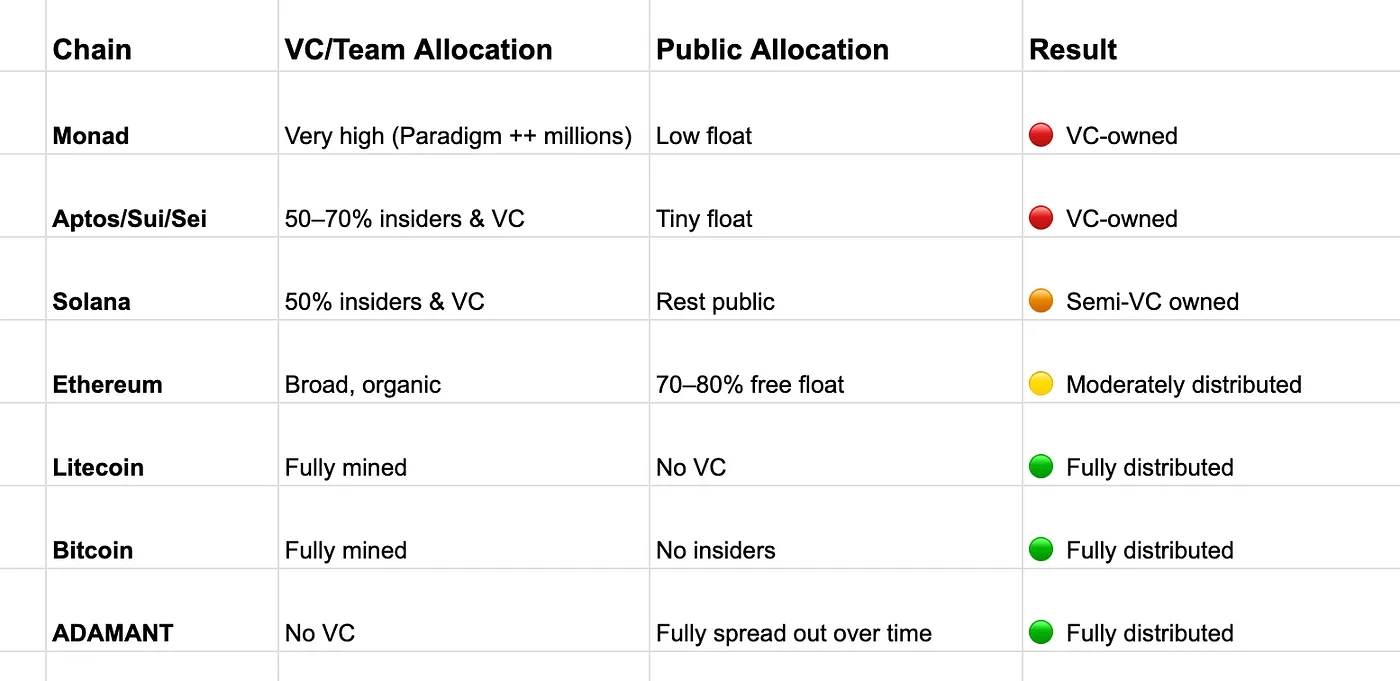
Many modern chains market themselves as offering “Web-scale decentralization” or “high TPS without sacrificing security.” In reality, if only 0.01% of users can run a node, it is not a decentralized system—it is a CDN with a token. It is better to have an honestly centralized system than a chain that pretends to be decentralized but isn’t. Honest centralization offers predictable governance and reliable performance, while hidden centralization creates false security assumptions and catastrophic failures.
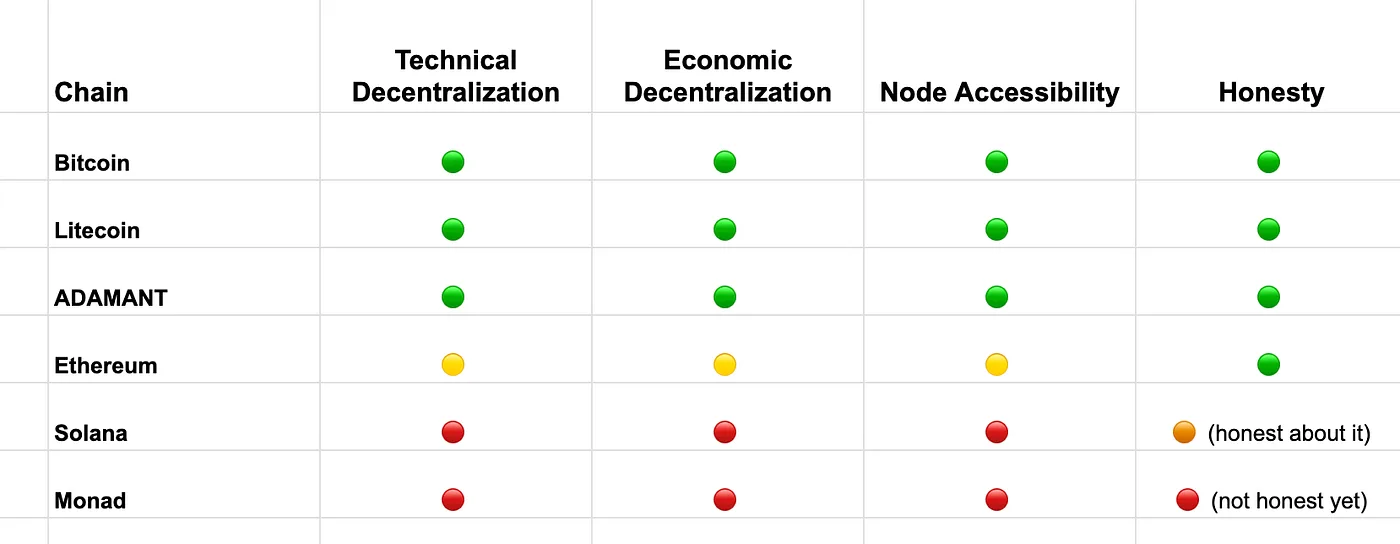
Conclusion: TPS is the new scam metric
Projects will keep promising thousands of TPS and faster chains. The conclusion is brutally simple: the more TPS a chain targets, the fewer humans can run it. The fewer humans can run it, the less decentralized and less secure it is. Real decentralization is not glamorous, fast, or VC-friendly. It is inexpensive, accessible, boring, resilient, and censorship-resistant. That is why systems like Bitcoin, Litecoin, and ADAMANT survive cycles.